By the balls: Football’s flagrant hold on ESPN

On Friday, the New York Times released a damning piece that revealed just how much of a grip the NFL has over ESPN, concerning the network’s participating in a documentary about players suffering from football related head injuries. The story has garnered a lot of attention within the sports media community, calling into question the journalistic integrity of ESPN as a result.

On a semi related note, you may recall an ESPN television show 10 years ago called “Playmakers,” which depicted a fiction pro football team overcoming day-to-day hurdles in a fiction pro football league. The NFL didn’t appreciate having such “hurdles” spotlighted — even if the show was fiction — and pressured ESPN into dropping the series.

On Saturday, the Times released another football related piece about ESPN, concerning the network’s influence in the creation of specific games, of which would also air on the ESPN networks. While not as damning as their now lack of involvement in investigating head injuries, this piece is still revealing, at least at the big picture level, as it concerns the relationship between media partnership.

The two type of above circumstances are not exclusive to ESPN or sports media. Concerning our news and political media, I’d argue that any agendas, whether it be the New York Times, NBC News or Fox News, are more often business/financially driven as opposed to being politically driven. Political talk radio should be the most obvious example (unfortunately, that is often missed by the hardcore fans of a Rush Limbaugh or a Glenn Beck).

Ball game or not, at the end of the day, news reporting is all business.

You can slam dunk that or bank on it. Whichever you prefer.

Ed Shultz roundabout at MSNBC

Ed Schultz

MSNBC announced yesterday that progressive talker Ed Schultz is moving back to weekdays, albeit, at the earlier time of 4 p.m. CT. Schultz was removed from the coveted 7 p.m. primetime slot earlier this year to make room for Chris Hayes, who has been a rising star in the progressive community.

Politico’s Dylan Byers explains how Hayes’ program “All In” has so far been unable to spark the ratings for primetime cable news. Moving Hayes to primetime was a very gutsy move, and one that might have been inspired by MSNBC President Phil Griffin’s heart rather than his head.

I wonder if moving Schultz to the 4 p.m. slot is the first step in what eventually results in a switch — moving Hayes to 4 p.m. while Schultz moves back to 7 p.m. That might be a clever way for Griffin to save face without completely embarrassing Hayes, someone who Griffin obviously thinks very highly of.

I am in the camp that prefers Schultz’s performance style over that of Hayes or Rachael Maddow. Hayes and Maddow are better at actively discussing important issues in a way that that might have more impact on an opposing mindset. In the short-term however, the added fire and showmanship of Schultz does a better job at keeping my attention.

Fox Sports 1 debuts with auto racing, Fox Sports 2 nowhere to be found

Fox Sports 1, the all new sports network by Fox, made its debut this morning by officially replacing Speed.

Fox Sports 1 has kicked off the festivities with the airing of auto race qualifying runs. The same thing most racing fans watched on the former Speed channel last Saturday morning.

Yes, Fox Sports 1 is a big picture project. Don’t judge the network for another five to 10 years once they can capture other big name sports. Yet with all the self-hype going into this new all sports network that is not ESPN, to have the first day flogged with auto racing seems highly ironic. It comes more across like a sorry plea to Speed channel viewers — “We’re sorry! We still love you and your NASCAR. We promise! Please don’t leave!”

Meanwhile, if Fox Sports 1 is the new golden prize of Fox Sports, then Fox Sports 2 is the bastard stepchild. By design, the press for Fox Sports 2 has been minimal, if non existent, and finding the bitch is nearly impossible. You sure won’t find it anywhere on the Fox Sports website.

Again, by design, Fox Sports 2 is more or less a spillover channel for Fox Sports 1. And they want all eyes on Fox Sports 1 today, and understandably so. Yet by doing it this way, they are already telling everyone that Fox Sports 2 doesn’t matter. Not the best way to introduce a new brand, in my opinion.

Would have been better off saving the Fox Sports 2 launch for when they had a useful reason for its existence. From the way it appears now, when they will eventually need Fox Sports 2, it won’t be much different then finding your local Comcast SportsNet Plus channel.

Not quite gone, but soon to be forgotten: WGN Radio moves Mike McConnell to online only

WGN-AM 720 midday host Mike McConnell has been removed from the station’s on air line-up… kind of. He will now be heard, exclusively via the station’s website on WGNRadio.com’s Livestream Ch. 2, an online-only secondary stream channel (usually reserved for re-airing of older shows).

From Mike McConnell’s Facebook page earlier this morning:

Hello friends,

We’re starting something new today. A PODCAST!
Some of the show will be prerecorded and some live.

The live portion will stream at 11:00am cdt and your calls are welcome.

The phone number is WGN’s old number 312-591-7200.

When you call you will go directly on hold and hear the stream.

There is no call screener and for now I’m experimenting with how to best put it together.

The show will then stream in it’s entirerty at 3:00pm cdt.

I typed this whole damn thing myself believe it or not. Just part of my commitment to the listening public.

Talk to you later.

Mike Mc

For all intent and purposes, this appears to be the station’s way of getting around his contractual obligations. McConnell’s three year anniversary at WGN was Friday, Aug. 9. Though terms of his contract were not made public, speculation was his multi-year deal ran anywhere between three to five years.

Listeners wishing to listen to him will have to seek out WGN Radio’s Livestream Ch. 2 feed at WGNRadio.com. The show will be made available in the afternoon as a podcast. It will be interesting to see what kind of effort the station will make to promote McConnell’s online shows.

The station is now free to program anyone they wish during his 10am-3pm slot, which as of this writing, is written as “WGN DAYTIME” on WGN’s website. Various fill-in hosts are scheduled to host during those times for the rest of this week.

Today’s McConnell broadcast was described on air by the host himself as an “ill conceived concept.” McConnell is left to answer any calls himself, many of which so far have been wrong numbers. At times, random dial tones and other phone sounds are heard in the middle of breaks and sometimes during live segments. Today’s show appears to be a “shoot from the hip” test day, more or less to get the bugs out.

It would appear for now that WGN is attempting to utilize the high priced McConnell via the cheapest means possible.

With McConnell now out of the way, it would seem logical that the station will soon announce their revamped program scheduled sooner rather than later.

Newspapers await for an iTunes or Netflix model of their own

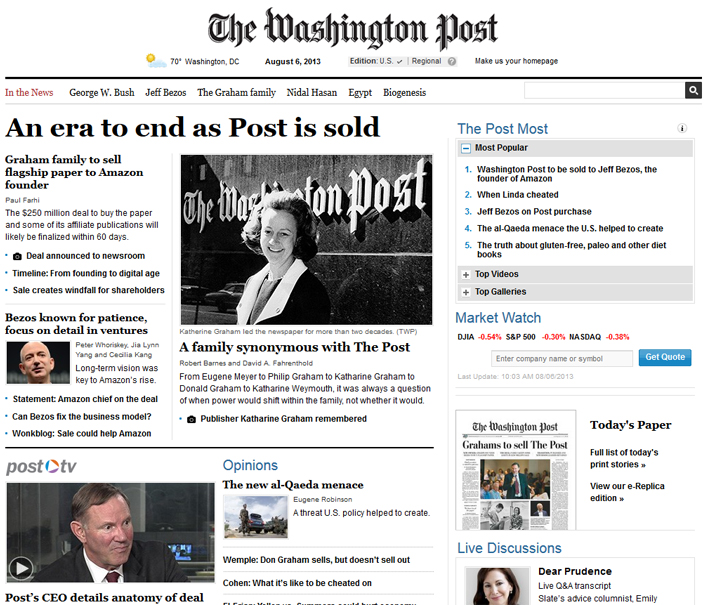
Farhad Manjoo wrote an excellent column for Slate explaining how Amazon.com CEO Jeff Blezo’s influence on e-commerce and marketing has been so innovative and how that might be relevant to the Washington Post.

Manjoo’s explains how the inexpensive information — and not necessarily the hard news — inside a newspaper played a huge role in attracting readers, and how the Internet curtailed that strategy.

For decades, newspapers made money by bundling two distinct kinds of data: low-cost information and high-cost news. The information—classifieds, stocks, sports scores, weather, entertainment listings, recipes, horoscopes, coupons, police blotters, obits—was widely popular and cheap and easy to produce.

… newspapers worked as a business, because they had a monopoly on the low-cost information. As long as there was no other place for their audience to go to for classifieds and all the rest, readers and advertisers kept paying for the ink, indirectly subsidizing the serious stuff.

Another column worth reading is by Cade Metz at Wired, about how Bezos’ Post purchase will likely tie with Amazon.

Metz also points out that high-cost news has not its own game-changing revolution the way music had via iTunes or movies via Netflix. Both iTunes and Netflix took existing products/services people already paid for and created a new model for them to receive the same but at less expense. Meanwhile, the best newspapers have come up with so far are paywalls behind their websites or mobile apps. Asides from the major publications, there’s no guarantee that model will work.

The thought of paying for online news is beyond outrageous among the young people today. You have the same problem, to a lesser extent, with music and movies, but the situation is a night and day difference because while newspapers have given their content away for free online for well over a decade, music and movies have not readily been available online for free. The workaround of downloading via BitTorrent (or previously with Napster) is illegal.

After a full day to think about it, the general consensus is that Bezos will somehow attempt to incorporate the Posts’s news content into the Amazon universe. And if Bezos is able to garner any type of success, it won’t be long before other tech giants, such as Google or Facebook, follow.

Will Jeff Bezos redefine the new normal for modern journalism?

wa-po-sold

There’s plenty of buzz coming from yesterday’s shocker that Amazon.com founder Jeff Bezos is purchasing the Washington Post. Obviously, the Post website has a lot of great content and reaction from various writers regarding the sale. Politico also has a variety of content worth checking out.

Dylan Byers has an excellent round-up of the purchase, what it potentially means down the road and more. Mad props as well for the headline “Bezos adds Washington Post to cart” (note, the headline has since been changed to “Jeff Bezos re-Kindles hope at The Washington Post” — still cute, but I like the original better).

I’m looking forward to observing how the Post evolves in the coming years, after enough time has passed for Bezos to implement his ideas and strategy. The looming question concerning newspapers is profitability and how to monetize the online and mobile app presence in order to pay for the high cost of journalism.

The last great hope is that someone like Bezos, a highly successful and innovate entrepreneur, and an outsider to the industry, can instill new ideas that result in a new money making model that other newspapers or news producing organizations may possibly borrow.

The demand for straight news on all mediums remains highly uncertain, as the soon to debut cable network Al Jazeera America is likely to soon find out. Can a news producing organization by itself be profitable? Before cable television, the respective news divisions at ABC, NBC and CBS were money losers that were primarily subsidized from the revenues generated from each network’s line of soap opera programming. I think something like that almost has to happen again, in a more modern sense of course.

Sam Zell’s purchase of the Tribine Company was the textbook example on how to turn a bad situation at a newspaper into a worse one. The combination of personal greed and unrealistic expectations curbed any chance Zell had from day one. I like to believe that Bezos is Zell’s opposite. I’m more willing to give him the benefit of the doubt  (as opposed to someone like Boston Red Sox owner John Henry, who is now eying to purchase the Boston Globe).

While we don’t yet know what Bezos’ expectations are for the Post, it might help if our expectations for Bezos remain in check. Running a news producing organization, such as one as large and influential as the Post, is quite the unproven endeavor in today’s modern world of journalism.

If Bezos turns out not to be the miracle man journalism has been waiting for, I have no doubts, it won’t be due to a lack of honest effort.

ESPN 1000 sinks further beneath the Score

wmvp-studioOn Friday, news broke that John Jurkovic, veteran host at WMVP-AM/ESPN 1000, was resigned to a multi-year renewal. This is the latest of moves made by the station plagued with years of downward ratings.

The impetus for ESPN 1000’s ratings woes by and large came in Jan. 2009 with the sudden exit of superstar host Dan McNeil, who months later would resurface on WSCR-AM/670 The Score. McNeil’s ESPN 1000 exit was a self-inflicted wound since it was Jim Pastor, the station’s then general manager, who gave him the boot.

McNeil’s former afternoon co-hosts Harry Teinowitz and Jurkovic were joined by Carmen DeFalo to help steer the ship, while Tom Waddle and Marc Silverman would continue to hold the fort during middays. Since then, it seemed to be a matter of when, not if, the “Waddle and Silvy” show would eventually move to afternoons.

Months turned into years, while ratings fell deeper, further distancing themselves from the Score.

In March, and a little more than four years following the station’s last significant programming change, ESPN 1000 was ready for change. Gone was Teinowitz, leaving DeFalco and Jurkovic the remaining two hosts in afternoons. In April, the station pulled the trigger on moving “Waddle and Silvy” to afternoons while “Carmen and Jurko” moved to middays (but not after also renewing DeFalco’s contract). A few other programming tweaks made room during the 9 a.m. hour for Colin Cowherd’s nationally syndicated ESPN Radio show, “The Herd.”

The station was quick to tout themselves as the “all new ESPN 1000.”

Ugh, perhaps, more like a fresh coat of paint?

While I don’t think the swapping of the “Carmen and Jurko” and” Waddle and Silvy” shows will mean much in the long-run, there are a few justifications for at least trying.

  1. Waddle and Silvy’s continued relationship with Bears quarterback Jay Cutler. With Cutler appearing as a weekly guest during Bears season, afternoons may allow for added exposure. This may hold more weight if the appearances take place as sponsored remotes, in which more people may be able to attend after their work day.
  2. Even though the Score’s “Boers and Bernstein” show is doing very well in the ratings, a lot of people don’t like the awkward, brash, silly and tension that often accompanies the show. Those not liking B&B who previously may not have warmed up to “Carmen and Jurko” may potentially warm up to “Waddle and Silvy.” This, however, is dicey because the many who can’t stand B&B still listen anyways (which is the same reason why people read Jay Mariotti in the Chicago Sun-Times each day).

Another glaring hole in the programming department is the “ESPN 1000 Post Game Show.” Featuring noteworthy segments from the day’s “Waddle and Silvy” and “Carmen and Jurko” shows, the 6 p.m. hour is more or less a throwaway. Since the station continues local programming on most weeknights from 7 to 10 p.m., would it hurt to eliminate the “Post Game Show” and offer an additional hour of live programming, preferably with Jonathan Hood?

I would like for ESPN 1000 to put up more of a fight. I’ve been listening on and off to AM 1000 since the mid 1990s (dating prior to the ESPN Radio takeover in 1998). I’ve also had the privilege of meeting some of their personalities through the years. Personal bias aside, I admit that my ESPN 1000 listening has decreased in sync with other Chicago sports fans who now get most of their sports talk from the Score.

Four months after the swapping of the “Carmen and Jurko” and “Waddle and Silvy” shows, ratings appear to be stagnant. And with Teinowitz’s firing in March, he so far is the lone scapegoat for the station’s ratings woes.

For all we know, overtaking the Score may not be the ultimate goal for ESPN 1000 management, or that of ESPN Radio corporate in Bristol, CT. As long as revenues meet expectations, they just might be content with second place.

On the surface, that appears to be the playbook they are abiding by.

Sirott and Murciano warming up for soon to be full-time work at WGN

Bob Sirott and Marianne Murciano, the soon to be full-time WGN-AM 720 hosts, are warming up the pipes in anticipation for their eventual debut to weekdays. As for now, they are simply filling in for the vacationing Mike McConnell. The couple filled in yesterday from 12  to 3 p.m. and will be on again tomorrow and Monday from 10 a.m. to noon.

Though WGN President and General Manager Jimmy de Castro acknowledged the couple’s hiring to Chicago media journalist Robert Feder, no official start day or time slot has been announced.

Larz at ChicagolandRadioandMedia.com has repeatedly hinted that McConnell, who now holds down the 10 a.m. to 2 p.m. slot (while the 2 p.m. hour is occupied by various part-time hosts) is likely on his way out in the coming weeks, leaving the entire 10 a.m. to 3 p.m. time up for grabs. Sirott and Murciano would likely inherit a two or three hour show within those hours while the remaining time could go to either Bill Leff, the station’s overnight host, or Steve Cochran, who recently returned to the station as a fill-in host.

Sunday night host Brian Noonan, who has been deemed a rising star, recently announced that he had accepted a full-time job outside of radio, thus eliminating him as potential replacement for middays.

At this time, the only sure thing is that Sirott and Murciano will soon be heard five days a week on WGN. Anything outside of that is simply rumor or speculation. For all we know, de Castro may have a few more aces up his sleeve, leaving the potential for this to play out completely different.

Though not rock bottom, the ‘Big 89’ WLS has fallen far from prominence

Plenty of chatter has been devoted to the pending exits of both Rush Limbaugh and Sean Hannity from the 40 or so Cumulus-owned news/talk stations they currently have shows broadcasting on. Locally, such a move would obviously have a significant impact on WLS-AM 890’s program schedule (Limbaugh 11 a.m. – 2 p.m.,  Hannity via tape delay 6-9 p.m.).

Further dents in the WLS program schedule is the last thing that station needs right now.

The current trainwreck at WLS was something I was meaning to bring up here, however, there was some good discussion about the station in recent days on the ChicagolandRadioandMedia.com message board.

There’s no question that WLS had a few rough months with the sudden death of midday host Jake Hartford and the exit of morning hosts Don Wade & Roma. Not helping was the reassignment of Drew Hayes (station’s operation director) to KABC-AM in Los Angeles. However, the rough patch the station had was near the end of 2012 and beginning of 2013. We’re on the eve of August and WLS is merely treading water with hands tied behind its back.

Personally, I’m not a fan of the new morning show with Bruce Wolf and Dan Proft. At least Don Wade or even someone like Jerry Agar (early midday host in 2008 and 2009, now early midday host at NewsTalk 1010/CFRB-AM in Toronto) understood radio and had an art for creating compelling discussion, even if you didn’t agree with them. Proft doesn’t come close. Instead he preaches, except when he is awkwardly tiptoeing around Wolf.

I have not listened to enough of John Kass and Lauren Cohn, the station’s early midday hosts, to have an honest opinion. Many people on the CRM board have written that Kass personifies the old  adage “a voice for print” (not sure if that is really an adage… if not, then I’m making it up). Kass often writes compelling content in his Chicago Tribune column, but from the little I have heard, it doesn’t carry over on the air while he is host.

I’ve been a listener of Roe Conn since the late 1990s when he was paired with Garry Meier. Conn’s show has had ups and downs through the years, depending on who he’s been partnered or sidekicked with. The current arrangement with Richard Roeper is not my favorite. Not sure if Roeper is the problem or if I grew tired of the Jim Johnson (now retired) and Christina Filliagi act. I’ve also been a victim of bad luck when attempting to listen to their show. I’ll say eight out of 10 times when trying, I hear commercials. The commercial breaks are long and often. Not helping is the ridiculous “Traffic & Weather – First on the Fives,” which after more than a year, are still prominently unsponsored (!).

The commercial content and repetitive traffic problems apply to the station’s morning and early midday shows as well.

I have a hard time getting past Conn’s continued stammering while telling a story. He often comes across as one with severe ADHD while telling a story and becoming distracted, either by someone else in studio or because a new thought popped into his head. I can put that aside because Conn is highly intelligent and has a fairly realistic point of view when it comes to analyzing the relevant news of the day.

The morning and early midday shows are incredibly dull and the chemistry during the afternoon show just doesn’t click with me.

As bad as it is at WLS, it could be a lot worse. Cumulus, the number two largest radio ownership in the country (which includes WLS), could have cancelled much of the local programming many months ago and had replaced it with syndicated crap. To their credit, they’ve resisted so far.

While things there could be a lot worse, they also could be a lot better. It’s a shame that no one else there seemingly thinks so.

Art Bell ‘Sirius’ about return to radio; satellite makes sense

It was only a few short months ago I wrote that Art Bell needs to stop steering his fans on a bumpy ride. His semi-frequent vague teases (via Facebook) always led to nowhere, leaving his many fans disappointed.

That all changed today with the announcement via ArtBell.com that the legendary overnight talk show host is launching a new radio show this September on SiriusXM,

Some of his fans will surely be disappointed that he is on satellite, which for at least $15 per month is not exactly cheap . At the end of the day however, satellite is more likely to give Bell everything he wants. He’s certainly entitled.

Bell has previously noted that the high amount of commercial content on the current “Coast to Coast AM” bothered him. On SiriusXM, commercials are limited.

Bell can be uncensored and seemingly no topic would be barred from discussion. Not sure how important that is to him, but such parameters mean Bell should have little restraints, if any. The minimal restraints, I’m guessing, is important to him. He will have a lot of freedom.

Even though Bell made a lot of money in his prime radio days, he’s going to make plenty more, further ensuring the long-term financial security of his family.

The limited commercials and the added freedom are two parameters Bell could have gotten if he had gone the podcast route. However, the guaranteed income would likely be less than what SiriusXM can offer. At the end of the day, Bell has every right to make as much money as he can.

And SiriusXM will still receive a hefty handful of new subscribers because of it.